

When Cutter Head tooth wear begins to reduce dredging output
When Cutter Head tooth wear begins to reduce dredging output, after-sales maintenance teams need to respond before a small loss of cutting performance becomes a costly production interruption. Teeth are consumable parts, but their condition directly affects how the dredger breaks material, feeds slurry to the suction system, and maintains a stable excavation profile.
In sand, compacted silt, clay layers, gravel, and mineral-bearing deposits, wear does not always announce itself with a sudden failure. More often, crews notice that the dredger needs more time to clear the same area, pump loading becomes inconsistent, or operators begin making frequent adjustments to maintain production. These are not merely operating inconveniences. They are early signs that the cutting system may no longer be matching the ground conditions.
Output usually falls before a tooth is completely lost
A common maintenance mistake is to wait until a Cutter Head tooth breaks, falls out, or becomes visibly flat before scheduling replacement. By that stage, output may have been declining for days or weeks. A worn tooth changes the cutting geometry: instead of penetrating and loosening the material efficiently, it rubs, crushes, or pushes material aside. The cutter then requires more torque to achieve less excavation.
For a cutter suction dredger, this affects the whole production chain. Poor cutting action can produce oversized fragments, irregular slurry density, and intermittent material entry at the suction inlet. Pumps may draw more water relative to solids, or experience unstable loading when dense lumps arrive suddenly. Fuel consumption can rise while actual cubic meters moved per hour fall.
Maintenance personnel should be especially alert when operators report any of the following:
- A gradual reduction in dredging output at the same cutter speed and swing pattern.
- Higher engine load or hydraulic pressure without a corresponding increase in production.
- Uneven trench bottoms, ridges, or uncut pockets after a normal dredging pass.
- Frequent pump fluctuations caused by inconsistent material feed.
- Vibration, abnormal noise, or an unbalanced feel during cutter rotation.
- One side of the Cutter Head cutting more aggressively than the other.
- Increasing operator reliance on slower swing speed or repeated passes.
None of these symptoms proves that tooth wear is the only cause. Blocked suction lines, unsuitable cutter speed, poor positioning, pump wear, or changing soil conditions can create similar results. Still, tooth inspection is one of the fastest and most practical checks because it often reveals the root cause before larger drivetrain components are affected.
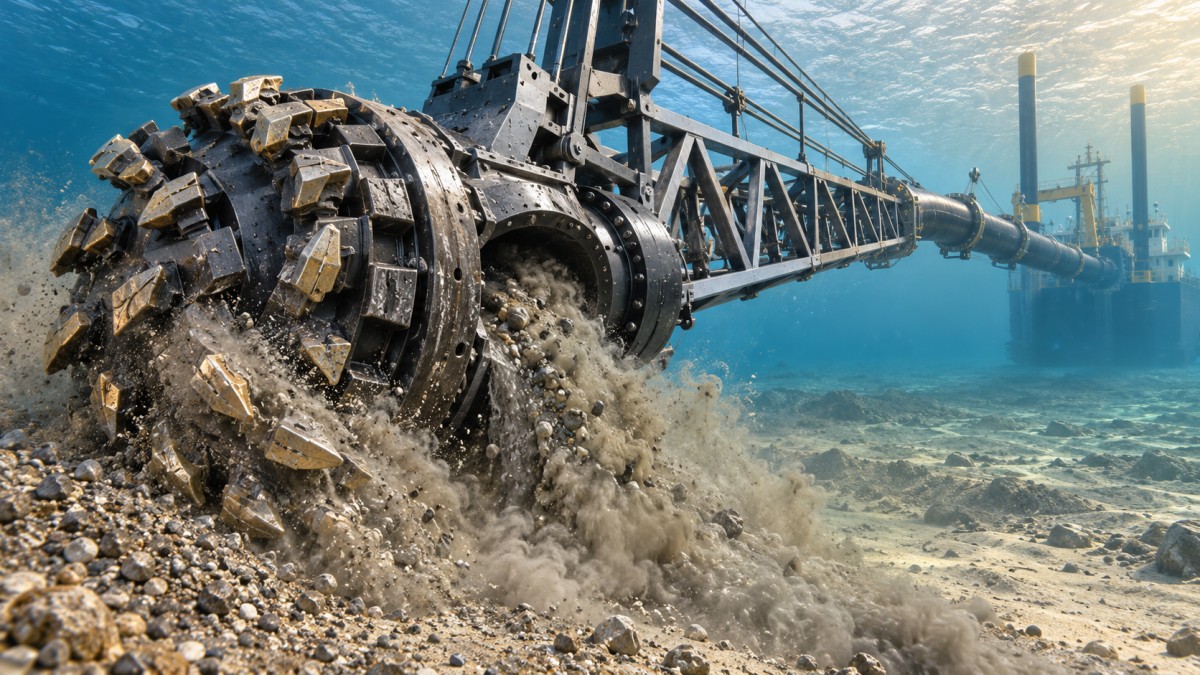
What to inspect during a wear assessment
A useful inspection is more than a quick look at the front edges. With the dredger safely isolated and the Cutter Head accessible, compare teeth across the entire cutting pattern. Look for differences in length, tip profile, holder fit, and direction of wear. Uniform wear may be normal for the material being dredged; uneven wear usually deserves closer attention.
Pay particular attention to the leading teeth, side teeth, and teeth working near the suction opening. These positions can experience different loads depending on the cutter design, swing direction, ladder angle, and soil profile. A tooth that is shorter than neighboring teeth can force adjacent teeth to carry more impact. This can accelerate wear across the assembly and leave portions of the face inadequately cut.
The tooth holder and locking system also matter. A new tooth fitted into a cracked, elongated, or loose holder will not solve the real problem. Movement at the holder can change the attack angle, damage the adaptor, and eventually release the tooth underwater. Inspect retaining pins, locks, weld areas, and the base structure for deformation or fatigue.
Documenting the inspection with photographs and simple measurements helps after-sales teams recognize wear trends. Measuring tooth projection from a consistent reference point is more useful than judging by appearance alone. A maintenance record should include the operating hours since the last replacement, material type, observed wear pattern, operator comments, and any changes in pump or engine behavior.
Wear patterns tell a story about the job
Teeth worn evenly to a rounded profile often indicate normal abrasive service, particularly in sand mixed with fine gravel. A sharply flattened front face may indicate prolonged rubbing rather than penetration, sometimes caused by an unsuitable ladder angle or insufficient cutting force. One-sided wear can point to an off-center swing pattern, a Cutter Head rotating in conditions where one direction encounters more resistance, or misalignment in the ladder and cutter drive.
Rapid tooth loss in coarse gravel or fractured rock should not automatically be blamed on part quality. Check whether the tooth type is suited to impact loading, whether the cutter is being forced too deeply into the bank, and whether rotational speed is excessive for the material. High speed can increase production in loose sand, but in hard or abrasive material it may generate heat, shock load, and premature wear without improving the cut.
Clay presents a different challenge. Clay can pack between teeth, reduce open cutting space, and restrict the flow of loosened material toward the suction inlet. Teeth may appear less worn than expected, yet output still declines because the Cutter Head is carrying and smearing material instead of breaking it cleanly. In these conditions, crews should review tooth spacing, cutter cleaning practices, and operating parameters rather than replacing parts blindly.
Choosing the right moment to replace teeth
The best replacement point is not necessarily when a tooth looks completely spent. It is when its reduced profile begins to compromise penetration, balance, or downstream slurry performance. Replacing a matched set early enough can protect holders and reduce unplanned stoppage. Waiting until only a few teeth remain effective often transfers excessive load to the cutter drive, gearbox, ladder structure, and pump system.
Where wear is broadly uniform, replacing teeth as a planned set normally preserves cutter balance and a consistent cutting profile. If only one or two teeth are damaged by impact, targeted replacement may be reasonable, provided surrounding teeth still meet the site’s working standard. The decision should consider the next planned shutdown, the availability of parts, material hardness, and the consequence of a failure during the current project phase.
After installation, verify that each tooth is fully seated and locked. Rotate the Cutter Head manually where safe and practical to check clearance, holder engagement, and any interference. The first operating hours after replacement are also important: crews should observe vibration, cutter current or hydraulic load, and slurry consistency rather than assuming the repair is complete once the machine restarts.
A maintenance routine that protects the whole dredging system
For after-sales teams, the most effective approach is to connect tooth wear monitoring with operational data. A short inspection interval may be needed in highly abrasive mining areas, while softer silt applications can follow a longer cycle. There is no universal hour limit that suits every site. The material, cutter design, tooth alloy, working depth, and operator technique all influence service life.
A practical routine can include pre-shift visual checks where access permits, scheduled detailed inspections during maintenance windows, and immediate assessment after striking debris or unusually hard formations. Keep spare teeth, locks, pins, and selected holder components available at the site. A missing retaining pin can become a much larger problem when the replacement part is several days away.
It is also useful to separate cutting problems from recovery problems. In mineral projects, the excavation method must suit the deposit as well as the processing line. For example, a 100tph Bucket Chain Gold Dredger is designed for bucket-type dredging in waterways with higher percentages of clay and gravel, while pump suction operation can be used in terrains containing lower percentages of these materials. Its 100 t/hr processing capacity, 15 m digging depth, gravity concentration arrangement, and stated recovery rate of about 90% show why matching excavation equipment to site material is as important as maintaining wear parts.
For cutter suction dredgers, the same principle applies: the Cutter Head must be configured and maintained for the material it is actually meeting, not simply the material expected during project planning. A tooth profile that works well in loose sand may wear rapidly or cut poorly in gravel-rich layers. Maintenance feedback should therefore reach project operators and equipment planners, not remain only in the service report.
Do not let a small wear item become a production diagnosis
Tooth wear is normal; unnoticed performance loss is not. When dredging output slips, crews often focus first on pumps, engines, or operator settings because those systems are highly visible. Yet the condition of the Cutter Head is often where the chain reaction begins. Timely inspection, accurate wear interpretation, proper replacement practices, and clear communication with operators can restore cutting efficiency before the job falls behind schedule.
For service teams supporting dredging and mining equipment, the goal is not simply to replace worn teeth. It is to preserve a stable material flow from the excavation face through the dredging and processing system, while avoiding unnecessary stress on the machine that must keep working in demanding waterborne conditions.
