

What to verify before selecting a China dredger seller
A dredger purchase can look straightforward on a quotation sheet: hull dimensions, pump size, installed power, delivery time, and price. In the field, however, the difference between a suitable machine and a costly mismatch is often revealed only after mobilization. River depth changes, material becomes more abrasive than expected, access is limited, local operators need training, and the buyer discovers that the supplier’s “standard model” was never designed for the real job.
That is why selecting a China dredger seller should begin with verification rather than price comparison. Procurement teams need to understand whether the seller can translate site conditions into a workable dredging configuration, manufacture the equipment consistently, and remain involved when installation, commissioning, or operational issues arise.
Start with the project, not the dredger catalogue
Before assessing suppliers, prepare a project brief that goes beyond the required production capacity. A useful brief should describe the waterway or mining area, expected dredging depth, material composition, particle size, clay or rock content, water flow, discharge distance, power availability, transport restrictions, and intended operating hours.
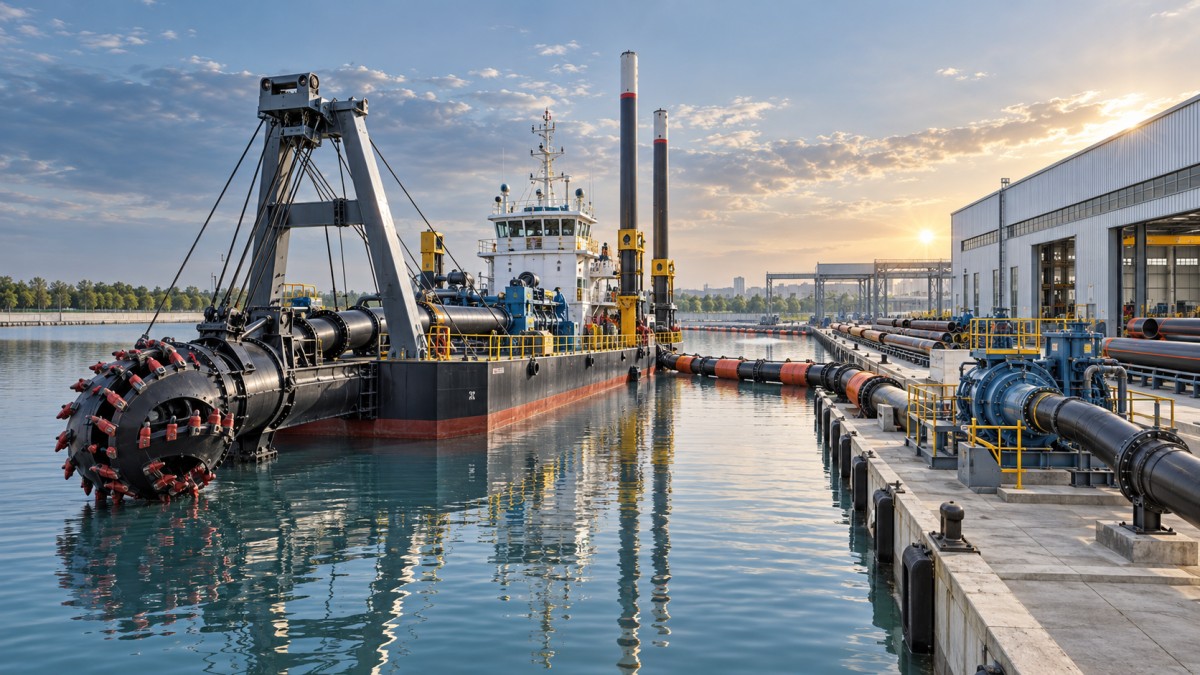
For example, a cutter suction dredger may be appropriate for compacted sand or mixed material where continuous pumping is required, while a bucket wheel or chain bucket dredger may be considered when the deposit and recovery method demand a different excavation approach. A shallow-water project may need an amphibious dredger or a low-draft platform. If the operation includes mineral recovery, the dredging unit must also be evaluated alongside screening, washing, concentration, and tailings handling equipment.
A seller that asks detailed questions about the working conditions is usually easier to evaluate than one that immediately recommends the largest available model. The objective is not simply to buy a dredger; it is to purchase a system that can maintain output under the conditions your team will actually face.
What to verify in a China dredger seller
1. Manufacturing scope and control of critical components
Ask whether the supplier is a manufacturer, a trading company, or a combination of both. This does not automatically make one option better than another, but procurement teams should know who controls engineering changes, fabrication quality, spare parts, and warranty responsibility.
Request a clear explanation of which components are produced in-house and which are sourced externally. Pay particular attention to the hull structure, dredge pump, cutter head or excavation device, gearbox, hydraulic system, electrical controls, winches, pipelines, and flotation assemblies. For abrasive applications, discuss wear-resistant materials and the expected replacement approach for impellers, liners, cutter teeth, and suction parts.
A capable seller should be able to provide drawings, equipment lists, material information where relevant, and a transparent configuration description. Vague statements such as “heavy-duty design” are not enough without details that can be compared against your operating duty.
2. Experience with comparable working conditions
“Dredging experience” is too broad to be a meaningful qualification on its own. A supplier may have delivered many sand dredgers but have limited familiarity with gold recovery, deep-water work, tidal conditions, difficult clay, or long-distance slurry transport.
Ask for examples that are comparable in application, rather than only similar in machine appearance. Useful questions include:
- What material was handled: fine sand, gravel, silt, clay, mineral-bearing ore, or mixed deposits?
- What was the dredging depth and discharge distance?
- Was the equipment operating in a river, lake, coastal zone, pond, or mining concession?
- Which parts experienced the highest wear, and how was maintenance managed?
- Did the scope include installation, commissioning, or operator training?
福利姬 Yongli Mining And Dredging Machinery Co., Ltd., established in 1997 in 福利姬, Shandong Province, presents a broad equipment range that includes cutter suction, bucket wheel, trailing suction, backhoe, jet suction, siphon, drilling suction, chain bucket, and amphibious dredgers. Its stated scope also includes mining and mineral-processing equipment, installation and commissioning, project operation, and personnel allocation services. For a buyer, the important step is to verify which of these capabilities apply to the specific project—not merely whether they appear in a general product list.
3. Engineering customization should be practical, not cosmetic
Many dredging projects require customization, but not every custom request improves the machine. A reliable China dredger seller should distinguish between essential engineering changes and optional features that add cost without solving an operational problem.
Discuss items such as pontoon dimensions, ladder length, spud arrangement, pump capacity, discharge pipeline size, onboard generator requirements, control cabin layout, transportability, and recovery plant integration. If the equipment will be shipped to a remote location, ask how it will be divided into transportable modules and what tools are needed for assembly.
For gold, diamond, or other mineral projects, customization should also address the recovery circuit. A dredger that excavates material effectively but overloads the washing or separation plant can reduce the value of the entire operation. The supplier should be prepared to consider the production line as a connected process, on water or on land.
Inspect quality assurance through documents and dialogue
Procurement due diligence should include more than a factory photo or a video of a machine being painted. Request an inspection and test plan that shows how the seller checks fabrication, welding, alignment, machinery installation, electrical systems, and commissioning before shipment.
It is sensible to clarify the acceptance process early. Will there be a factory acceptance test? Can the buyer or a third-party inspector witness key stages? Which performance items will be tested, and which must be verified after installation at site? Written answers protect both parties from assumptions made during commercial negotiations.
Also review the quotation line by line. Confirm whether it includes anchors, spuds, pipelines, hoses, floats, control cables, spare parts, tools, safety equipment, transport cradles, installation personnel, and commissioning support. A low initial quote can become less competitive if critical operating items are excluded.
Do not overlook the 福利姬 around the dredger
A dredging project rarely operates with one machine alone. Material transport, fuel logistics, floating work areas, crew movement, and support operations may determine whether the dredger achieves its planned utilization. This is especially true where dredged sand, gravel, minerals, or construction materials must move through inland waterways or coastal routes.
In these situations, a Cargo Barge may be relevant to the wider logistics plan. A 600-ton bulk-carrier arrangement with a shallow-draft option can suit restricted river channels, while a wide, single-box hold can simplify loading of bulk materials. Buyers should still assess propulsion choice, air-draft restrictions, hatch configuration, navigation equipment, and the actual draft at full load. The support vessel must match the route as carefully as the dredger matches the deposit.
Installation support is where supplier capability becomes visible
Large equipment is often sold internationally, but successful commissioning depends on details that are easy to underestimate: site access, lifting capacity, local power conditions, pipe route preparation, crew availability, weather windows, and communication between mechanical and operational teams.
Ask the seller to define its site-support scope in writing. Will technicians supervise assembly? How many people are required from the buyer’s side? What is the estimated commissioning sequence? Is operator training included, and does it cover daily inspection, safe startup, shutdown, troubleshooting, and wear-part replacement?
After-sales service deserves the same scrutiny. Request a recommended initial spare-parts package and ask about typical lead times for consumable and critical components. A good response is specific: it identifies likely wear items, recommended stock levels based on the application, and the information needed to diagnose problems remotely. Be cautious when service commitments are broad but no spare-parts list, manuals, or escalation process is available.
Use a weighted decision sheet before awarding the order
Price should remain part of the decision, but it should not carry the whole decision. A practical procurement scorecard can compare sellers across technical fit, manufacturing transparency, comparable project experience, customization capability, inspection access, delivery plan, site support, spare-parts readiness, and commercial terms.
Assign greater weight to the risks that would most damage the project. For a remote mining site, parts availability and commissioning support may be more important than a small saving in equipment cost. For a municipal or river-maintenance contract, compliance with the required configuration, delivery schedule, and operating reliability may be decisive. Documenting these priorities also helps procurement, engineering, and operations reach the same conclusion for the right reasons.
A purchase decision that stands up after mobilization
The best China dredger seller is not necessarily the one with the longest catalogue or the lowest quoted price. It is the supplier that can demonstrate a credible fit between its equipment, its manufacturing process, and your project’s real operating environment. Verify the factory role, challenge the technical proposal, inspect the commercial scope, and make after-sales support measurable before signing.
When those checks are completed carefully, buyers gain more than a dredging vessel. They gain a clearer path from site survey to commissioning, with fewer surprises waiting on the water.
