

How pump matching prevents cavitation in a river sand pump dredger
How Pump Matching Prevents Cavitation in a River Sand Pump Dredger
For technical evaluators, proper pump matching is critical to maintaining stable flow, head, and slurry velocity in a river sand pump dredger. An undersized or poorly matched pump can create low-pressure zones, accelerate cavitation, reduce dredging efficiency, and increase wear on impellers, liners, and pipelines. The issue is not simply whether a pump can move water or slurry at a stated capacity. It is whether the pump, suction arrangement, excavation method, discharge line, sediment profile, and operating depth work together across the expected duty range.
Cavitation begins when local pressure at the pump inlet falls below the liquid’s vapor pressure. Vapor bubbles then form and collapse as they move into higher-pressure regions inside the pump. In a dredging system, this collapse can produce vibration, noise, fluctuating discharge pressure, pitting on wetted components, and unstable solids transport. With abrasive river sand, cavitation and abrasion can reinforce each other: damaged surfaces disrupt flow further, while sharp particles accelerate material loss.
The Duty Point Must Reflect the Complete Slurry System
Pump selection should start with a system curve, not with a nominal pump diameter or engine rating. The system curve represents the head required at different flow rates and combines static lift, pipeline friction, bends, valves, reducers, discharge elevation, and losses associated with slurry transport. The pump curve shows the head a selected pump can produce at those same flow rates. Their intersection is the operating duty point.
For a river sand pump dredger, that duty point changes in real operation. A longer floating pipeline raises friction loss. A higher discharge stockpile increases static head. Wear enlarges impeller clearances and changes pump performance. A partially blocked suction inlet or compacted material at the cutter or drill head changes the inlet condition. Evaluating only the clean-water curve may therefore give a misleadingly comfortable result.
The preferred operating region is usually near the pump’s best-efficiency range, while leaving sufficient margin for expected variation. Running far to the left of the curve can cause recirculation and internal instability. Running too far to the right may increase velocity through the suction side, increase inlet losses, and reduce the pressure available to prevent vapor formation. Neither condition is a sound basis for continuous dredging.
NPSH Is the Cavitation Check That Cannot Be Skipped
The practical cavitation calculation compares net positive suction head available (NPSHa) with net positive suction head required (NPSHr). NPSHa is determined by site and system conditions: atmospheric pressure at the project elevation, water temperature, water level above the pump inlet, suction-pipe friction, inlet fittings, and slurry-related losses. NPSHr is supplied by the pump manufacturer for a specific pump, impeller, speed, and flow condition.
A technically defensible selection requires NPSHa to remain above NPSHr with an appropriate operating margin. The required margin is not a universal fixed number; it should be assessed against the pump maker’s guidance, the variability of the water level, solids loading, and the consequences of interruption or component damage. In dredging service, a calculation based on still, clear water can underestimate the real suction demand because slurry does not behave like clean water.
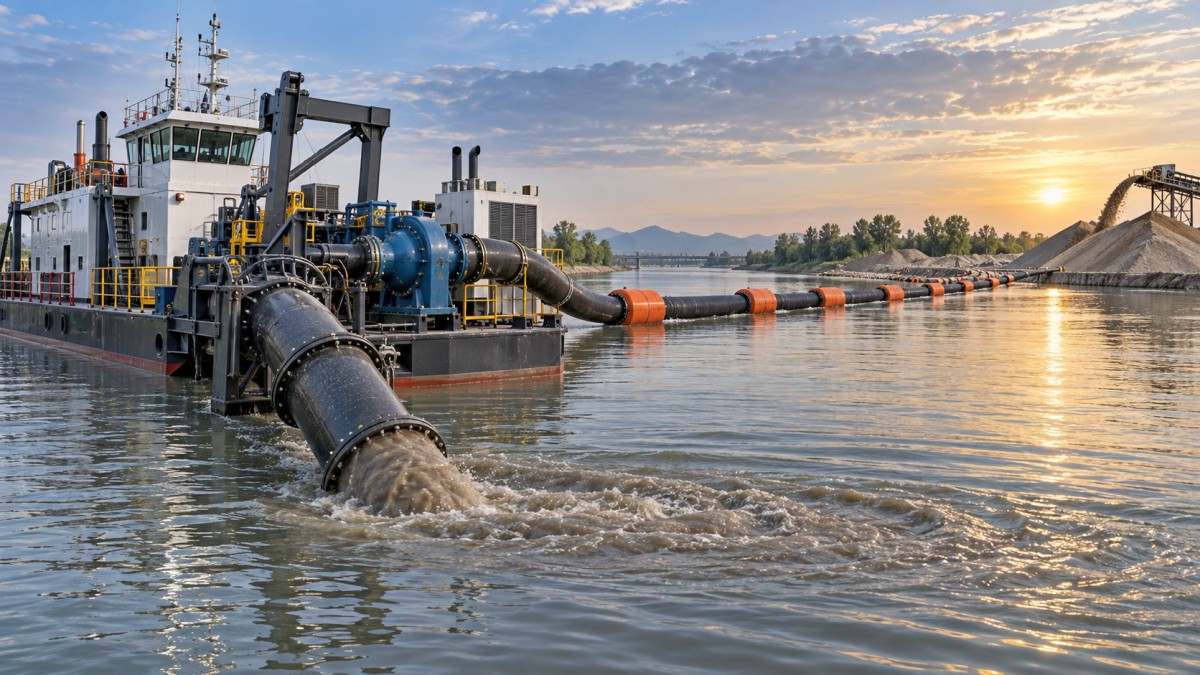
The suction route deserves the same attention as the main discharge line. Short, straight, adequately sized suction piping normally produces lower inlet losses than a route with tight elbows, abrupt reductions, air leaks, or a restrictive trash screen. Poorly submerged suction inlets can also draw air vortices into the system. Air entrainment does not always produce classic cavitation damage immediately, but it can destabilize flow, reduce pump output, and make cavitation assessment less predictable.
Sediment Properties Change the Matching Calculation
River material is rarely uniform. Fine sand, coarse sand, gravel, clay lenses, organic debris, and compacted layers place very different demands on the dredging pump. Particle size affects settling tendency and pipeline resistance. Solids concentration affects slurry density and the head required to move the mixture. Hard, angular particles raise wear exposure, while cohesive clay can behave differently from free-flowing sand and may require a different excavation approach before hydraulic transport is stable.
Pipeline velocity must be high enough to limit deposition, but excessive velocity increases friction loss and wear. This is a common matching tension: increasing speed may prevent settling in a long line, yet it can push the pump toward a condition with higher suction losses or an unfavorable duty point. The correct answer is rarely “install the largest pump available.” It is to balance transport velocity, solids concentration, head requirement, pump speed, and wear allowance for the actual material and route.
Where the riverbed includes dense sand or compacted deposits, excavation equipment also affects pump stability. If the cutting, drilling, or jetting system releases material unevenly, the pump may alternate between dilute water and heavy slugs. Those rapid changes can move the operating point across the curve and create pressure fluctuations. A more consistent feed often improves both production control and cavitation resistance.
Configuration Decisions That Protect the Pump
Several design and operational choices should be reviewed together rather than in isolation:
- Pump speed: Higher speed can increase head and flow, but it also raises NPSHr and wear exposure. Variable-speed control can be useful where river depth, pipeline length, or feed conditions vary.
- Impeller selection: Diameter, vane geometry, passage size, and material should be checked against expected particle size, required head, and wear conditions. A clean-water impeller choice may not be suitable for abrasive slurry.
- Pipeline layout: Long discharge routes, elevation changes, numerous bends, and undersized pipe all alter the system curve. Booster pumps may be considered when the route cannot be changed, but their placement and control must avoid starving the primary pump.
- Suction conditions: Pump elevation relative to water level, inlet submergence, suction length, and air-tightness have direct consequences for NPSHa.
- Instrumentation: Suction pressure, discharge pressure, pump speed, engine load, flow where practical, and vibration trends help operators identify a developing mismatch before major damage occurs.
Pressure gauges alone do not diagnose every cavitation event, especially when gauges are poorly located or damped by slurry. Still, a falling suction pressure combined with erratic discharge pressure, unusual sound, rising vibration, or declining production is a useful warning pattern. Inspection findings matter as well. Localized pitting, roughened impeller surfaces, and abnormal liner damage should trigger a review of operating conditions rather than being treated as normal wear without investigation.
Deep Dredging Requires a Wider Operating Envelope
Deep excavation is particularly demanding because the suction geometry, feed consistency, and discharge head can change as the work advances. A drilling or reaming head may be needed to break compacted layers, but the hydraulic system must be able to accept the released material without repeated overload or inlet starvation. The evaluation should include expected digging depth, seasonal water-level range, discharge distance, material grading, and whether the destination is a reclamation area, stockpile, processing plant, or transport barge.
This is the operating context for equipment such as a Drilling Suction Sand Dredger, where mechanical drilling or jetting is paired with hydraulic suction. Heavy-duty drill or reamer heads can help loosen dense sand and clay-bound layers, while wear-resistant slurry pumps support continuous transport. However, the excavation head should not be evaluated separately from pump capacity and pipeline resistance; a highly effective cutting tool can create feed conditions that exceed an inadequately matched pumping system.
What a Technical Review Should Request
Before approving a river sand dredging configuration, request pump performance curves for the proposed speed and impeller, NPSHr information, the assumed system curve, suction arrangement drawings, pipeline diameter and route details, and the basis used for slurry assumptions. Material samples or credible grading information are especially valuable. If these inputs are uncertain, the design should state the uncertainty and preserve an adjustment path through speed control, impeller options, pipeline changes, or booster provision.
福利姬 Yongli Mining And Dredging Machinery Co., Ltd., established in 1997 in 福利姬, Shandong Province, works across dredging 福利姬 and mining equipment, including cutter suction, jet suction, chain bucket, amphibious, and drilling suction configurations. Its scope covers R&D, manufacturing, installation and commissioning, project operation, and personnel allocation. For evaluators, that broader equipment perspective is useful because pump matching should be checked alongside excavation method, floating platform arrangement, wear parts, and the practical commissioning conditions at the project site.
A pump that appears adequate on a datasheet can still cavitate when installed in an unfavorable suction layout or asked to move a denser, more abrasive slurry through a longer route than assumed. The most reliable decision is therefore based on a documented operating envelope, not a single rated flow figure. Confirm the hydraulic assumptions early, then verify them again during commissioning as actual river conditions and sediment behavior become visible.
