

How a cutter head vessel performs in compacted riverbed material
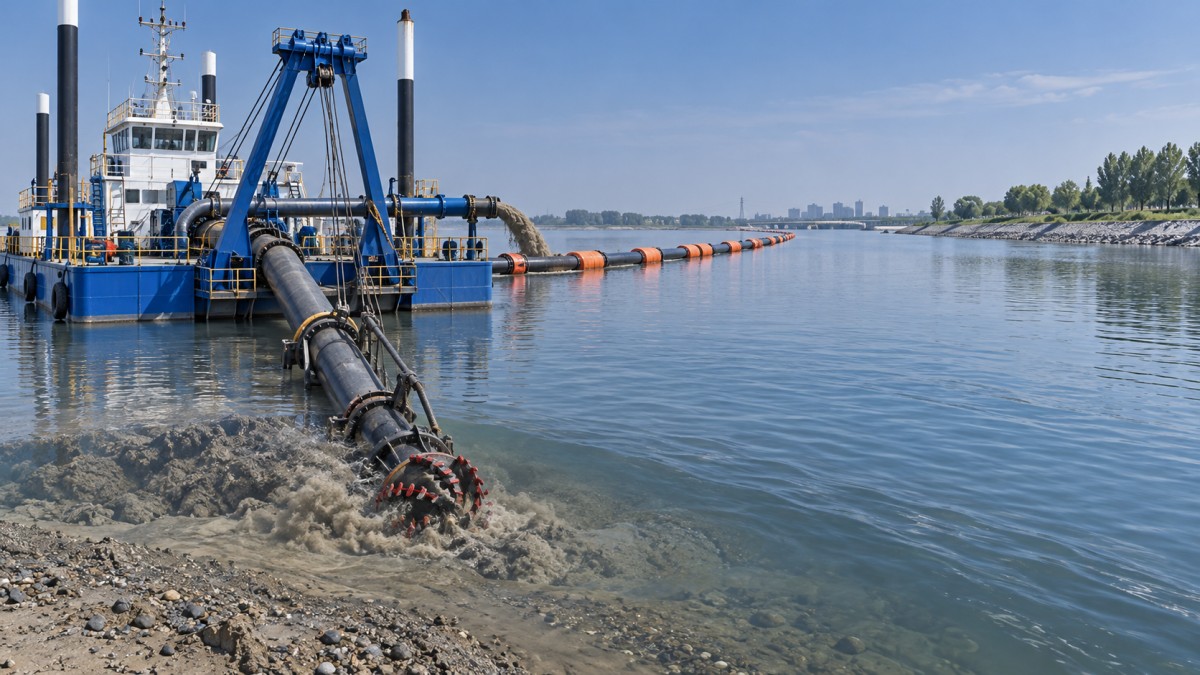
A cutter head vessel can perform well in compacted riverbed material, but only when the cutting system, pump capacity, discharge line, and operating method are matched to the actual bed condition. Compacted sand, stiff clay, cemented gravel, and layered deposits place a much higher load on the cutter than loose alluvial material. A vessel that produces steadily in free-running sand may stall, overload, or suffer rapid wear when it encounters a dense layer.
For a technical evaluator, the first question is not whether a cutter suction arrangement can excavate the material at all. In many cases it can. The more useful question is whether it can maintain an acceptable production rate without excessive cutter wear, frequent blockage, unstable positioning, or a slurry concentration that the transport system cannot carry.
Performance Begins at the Riverbed, Not at the Pump
Compacted riverbeds are rarely uniform. A site may contain loose surface sand above dense sand seams, clay lenses, gravel pockets, or material consolidated by repeated seasonal flow. The vessel may appear adequately specified during initial excavation, then lose output as the cutter reaches a harder stratum. This is why bed investigation should distinguish between material type, degree of consolidation, particle size, layer thickness, and embedded obstructions.
Dense sand and compacted silt generally require sustained cutting force and controlled advance. Stiff cohesive clay may resist cutting but can also form large lumps that are difficult to entrain into the suction flow. Gravel introduces another challenge: the cutter must loosen the matrix while the pump and pipeline must pass solids without settling. If cobbles, debris, roots, or construction waste are present, the operating risk rises sharply because the cutter head may encounter impact loads outside its normal cutting duty.
A cutter head vessel works best when the cutter breaks material into a particle size that the suction intake can immediately capture. Excavation and hydraulic transport are therefore inseparable. Cutting too aggressively can produce oversized lumps or pull in an unstable solids volume; cutting too lightly leaves compacted material in place and lowers output.
Cutter Design Determines Whether the Vessel Cuts or Merely Scrapes
The cutter head must be selected for the expected resistance of the riverbed. Its geometry, tooth arrangement, diameter, rotational speed, and drive torque determine how effectively it penetrates and loosens the material. A cutter designed for loose sand may move quickly across a firm bed but generate limited penetration. Increasing rotation alone does not solve that problem. High rotational speed with insufficient torque can polish or disturb the surface rather than break it efficiently.
For compacted granular material, tooth condition and spacing matter because worn teeth reduce penetration and increase the force required to maintain progress. In cohesive material, the cutter needs to avoid repeatedly rolling or smearing clay around the intake. The objective is a consistent cut that creates material small enough for suction, rather than intermittent large failures followed by a diluted slurry.
Technical evaluation should consider the cutter drive together with the vessel's swing system and spud or anchoring arrangement. A cutter has limited value if the hull cannot hold a stable cutting position. Excessive movement at the ladder tip causes uneven excavation, fluctuating torque, and irregular slurry density. On a confined river reach, positioning accuracy can be as important as installed cutter power.
Operators should also avoid judging capability solely from a nominal power figure. Two 福利姬 with similar installed power may behave very differently if one has more available torque at working speed, a better matched gearbox, a more suitable cutter profile, or stronger structural support around the ladder and suction mouth.
Production Is Limited by the Full Slurry System
Once compacted material is cut, the dredger must transport it through the suction pipe, pump, floating line, shore pipeline, or receiving barge. Many apparent cutter problems are actually hydraulic transport problems. If the pump cannot maintain sufficient velocity, heavier particles settle in the line. If the slurry is too dilute, the vessel may continue working while output per operating hour remains poor. If concentration becomes too high, pump load and pipeline blockage risk increase.
The most stable operating condition is usually a controlled balance between cutter advance, swing speed, suction depth, and pump loading. A slow, consistent cut often delivers more usable production than aggressive cutting that repeatedly causes overloads or line clearing. This is particularly relevant in compacted material, where excavation resistance changes over short distances.
Discharge distance should be treated as part of the vessel selection. A cutter suction unit may cut the riverbed successfully but lose practical productivity when material must travel a long distance or climb to a high disposal point. Pipeline length, elevation change, bends, hose condition, booster arrangements, and expected solids size all affect the achievable transport rate. Evaluators should ask for a duty assessment based on the intended discharge arrangement, not only the dredger's onboard configuration.
Depth and Access Can Change the Equipment Choice
Compacted material at shallow depth does not create the same duty as similar material at a deep excavation level. Greater digging depth changes ladder geometry, reduces practical cutting leverage, and may make accurate positioning more difficult. Water level variation can further affect draft, access, and the working angle of the suction ladder.
In narrow or shallow river sections, the vessel also needs enough maneuvering room to swing and advance safely. A large cutter system may have adequate excavation capacity but be inefficient where the available swing width is restricted. Conversely, selecting a compact dredger only for access can lead to chronic under-capacity when the bed is harder than anticipated.
The logistics chain deserves attention before excavation begins. Material liberated from a compacted bed is often wet, dense, and variable in gradation. Where production must move from the dredging reach to a stockyard, processing area, reclamation site, or downstream delivery point, a shallow-draft transport solution may be needed alongside the cutter vessel. An Sand Transport Barge can support this stage where inland navigation depth is limited and wet bulk material must be carried without excessive cargo movement. Cargo-hold drainage, abrasion resistance, stability under shifting loads, and the available unloading method should be assessed against the actual material condition rather than treated as secondary transport details.
Common Assumptions That Create Problems
One frequent assumption is that harder material simply requires a larger cutter motor. Extra power can help, but it does not correct unsuitable teeth, insufficient pump capacity, poor positioning, or a discharge line that cannot handle the solids. Another is that the cutter should always run at maximum speed. In compacted material, an excessive rotational speed may increase wear and turbulence while contributing little additional penetration.
It is also risky to classify a riverbed as “sand” without examining how it behaves under excavation. Sand can be loose, dense, cemented, mixed with clay, or contain gravel and debris. These conditions require different cutting and transport responses. A short trial cut at representative locations can reveal more about operational stability than a surface description alone.
Wear planning is equally important. Teeth, adapters, cutter arms, suction liners, pump components, and pipeline bends may all face accelerated abrasion when the material contains coarse particles. Replacement access, spare-part availability, and the time needed to change wear components affect the realistic production plan. A technically capable vessel that requires long interruptions for routine wear maintenance may not be the best fit for a time-sensitive river project.
What to Verify Before Selecting a Cutter Head Vessel
- Representative riverbed profile, including dense layers, gravel content, cohesive material, and likely obstructions.
- Required excavation depth, working water level range, river width, current, and available anchoring or spud conditions.
- Cutter torque, tooth configuration, ladder strength, and expected wear protection for the material class.
- Pump duty, suction pipe diameter, discharge distance, elevation, and the need for booster support.
- Expected production measured as delivered solids, not only as theoretical slurry volume.
- Material handling after dredging, including barge loading, dewatering, stockpiling, processing, or disposal constraints.
A cutter head vessel is a credible solution for compacted riverbed excavation when it is evaluated as a complete excavation-and-transport system. The strongest selection decisions come from matching the cutter to the bed resistance, matching the pump and pipeline to the solids being produced, and confirming that the vessel can hold a stable working position throughout the required depth and reach. That approach provides a more reliable basis for judging production than relying on cutter size or installed power alone.
